Jonathan Schaffer
Gulf Coast Concepts · 4 min read
You have a logo. You have brand colors. You probably have a tagline you wrote at 11pm that still makes you proud. None of it is sticking.
That is the problem most Southwest Florida business owners run into once the basics are done. The brand exists on paper, but it does not exist in anyone's head. People scroll past the post, forget the name by lunch, and remember the vibe of your competitor's mascot instead of your actual offer. That is not a content problem. It is a memory problem. And memory problems have a specific, well-documented fix.
We just introduced our own version of this — Swoop, the pelican behind the Pelican Method. Before that, though, it is worth laying out why a mascot works in the first place, because the reasoning applies to your business just as much as ours.
People Remember Characters, Not Taglines
Brand recall is not built on clever copy. It is built on something the brain can latch onto and replay. Research on advertising and visual attention consistently shows that ads featuring a branded character carry a real recall advantage over ads that rely on logo and copy alone. The mechanism is simple. A character gives an abstract business a face. Once there is a face, there is something to picture, something to draw, something a kid can point at in a grocery aisle. Pelicans, geckos, tigers. The character becomes the retrieval cue for the entire brand.
This matters even more for service businesses, which is most of what we work with at GCC. A landscaping company, a bookkeeping practice, a fabrication shop — none of these have a product on a shelf doing the remembering for them. A mascot gives an intangible service something tangible to hang onto in a customer's mind. That is the gap a mascot is built to close, and it is the same gap most local businesses are sitting in right now without realizing it.
A Mascot Is Also a Trust Shortcut
There is a second piece that gets missed. A mascot does not just help people remember you. It changes how they feel about you. Studies on spokes-characters have found that mascots designed to come across as sincere and likable increase brand trust and even willingness to pay more for the same product. A character with personality does relationship-building work a static logo cannot.
A mascot also tends to outlast trends that depend on a single person. A celebrity endorsement expires the moment that person signs with someone else, or says something dumb on the internet. A mascot you own stays exactly that — yours — and it keeps showing up the same way every time, which is half of what builds trust in the first place.
The Practical Takeaway
If you are sitting on a logo that nobody talks about, do not start by redesigning the logo. Start by asking what character could carry your brand's personality if your logo could not speak for itself. It does not need to be a literal animal in a costume. It can be a simple illustrated figure that shows up in your social posts, your email signature, your packaging, or your booth at the next SWFL market. The goal is one consistent character your audience starts to recognize before they even read your name. That recognition is the asset. Everything else — the merch, the costume, the plushie — comes after the character is doing its job.
What This Actually Looks Like in Practice
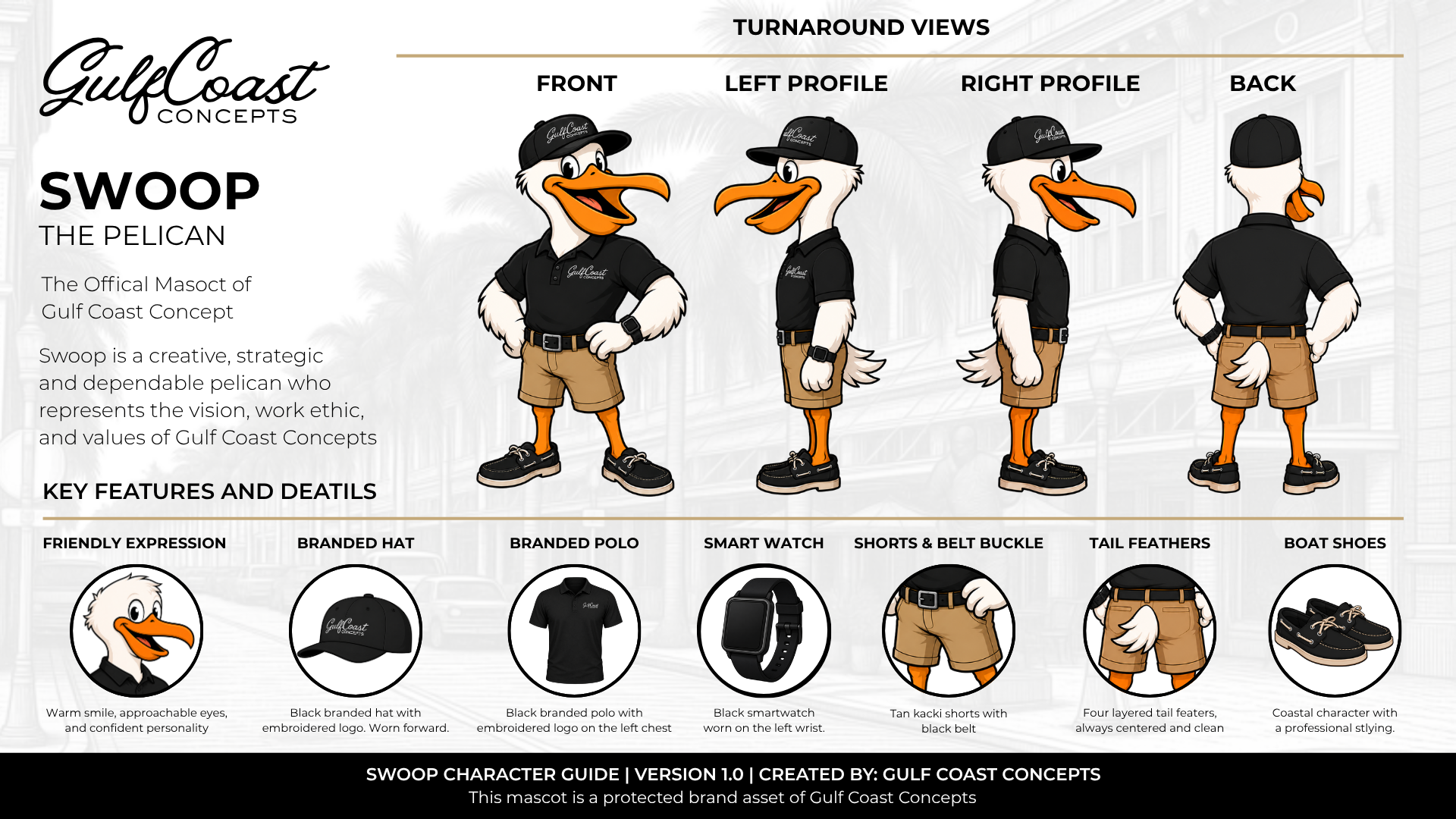
That is Swoop, broken down the way we would break down any mascot we build for a client. The pose, the color palette pulled straight from our brand guidelines, and each stage of the Pelican Method™ — Perch, Soar, Lock, Dive, Catch, Flock — mapped to a specific look and behavior for the character. This is not just art. It is a system. A mascot only works if it stays consistent everywhere it shows up, and that consistency starts with a reference sheet like this one.
This is also exactly the kind of deliverable GCC builds for clients. Not just a drawing of a character, but the full breakdown behind it — what the character represents, how it should look across different formats, and how it ties back to the brand it is representing. If you read Say Hello to Swoop and want to know what goes into building something like that for your own business, this is the blueprint.
Why This Is Worth Building With Someone Who Has Already Done It
Building a mascot the right way takes more than a fun drawing. It takes a clear voice, a visual system that holds up across every platform, and a plan for where the character actually shows up in your marketing. We just went through that process ourselves with Swoop, so we know firsthand what it takes to get a character off the page and into a brand's daily rhythm.
That is exactly the kind of work GCC does. If your brand has the bones but is missing the face people remember, we should talk about what your version of Swoop looks like.
Jonathan
Have a question about this? Reach out directly.