Jonathan Schaffer
Gulf Coast Concepts · 6 min read
I used to play Fantasy NASCAR, and the scoring system stuck with me longer than any race result did. You drafted drivers into tiers. The A group was your top competitors, the ones who could realistically win on any given Sunday. The B group was your main field of solid contenders, drivers who would consistently finish well without ever being the headline. The C group was everyone else, including a lot of part-time drivers who only ran select races, often older veterans who knew specific tracks cold and brought experience the younger field didn't have.
The longer I run Gulf Coast Concepts, the more I think that scoring system is a better model for building a team than most of what gets taught about A-players and C-players in business.
The common version of that framework treats A-players as the only people worth keeping and C-players as dead weight you tolerate until you can replace them. I don't think that holds up, and Fantasy NASCAR is actually the better analogy for why. In that world, your C-group drivers weren't bad. They were specific. They ran the tracks they knew, on the schedule that made sense for them, and they brought something the A-group couldn't replicate, which was a depth of experience in a narrow lane. You wanted them on your roster. You just didn't expect them to carry the same load as your top tier.
I think the same is true on a real team. Your A-players are the ones showing leadership instincts before you've handed them a title, the ones whose critical thinking around the actual work keeps getting sharper. Your B-players are your steady main field, the people who show up, do the job well, and keep the business running day to day without needing to be managed closely. And your C-players — the real equivalent of those part-time veteran drivers — are often your most experienced people. They might be older, working specific shifts that fit their life, but they carry institutional knowledge and judgment that took years to build. That is not a liability. That is a resource, used the right way.
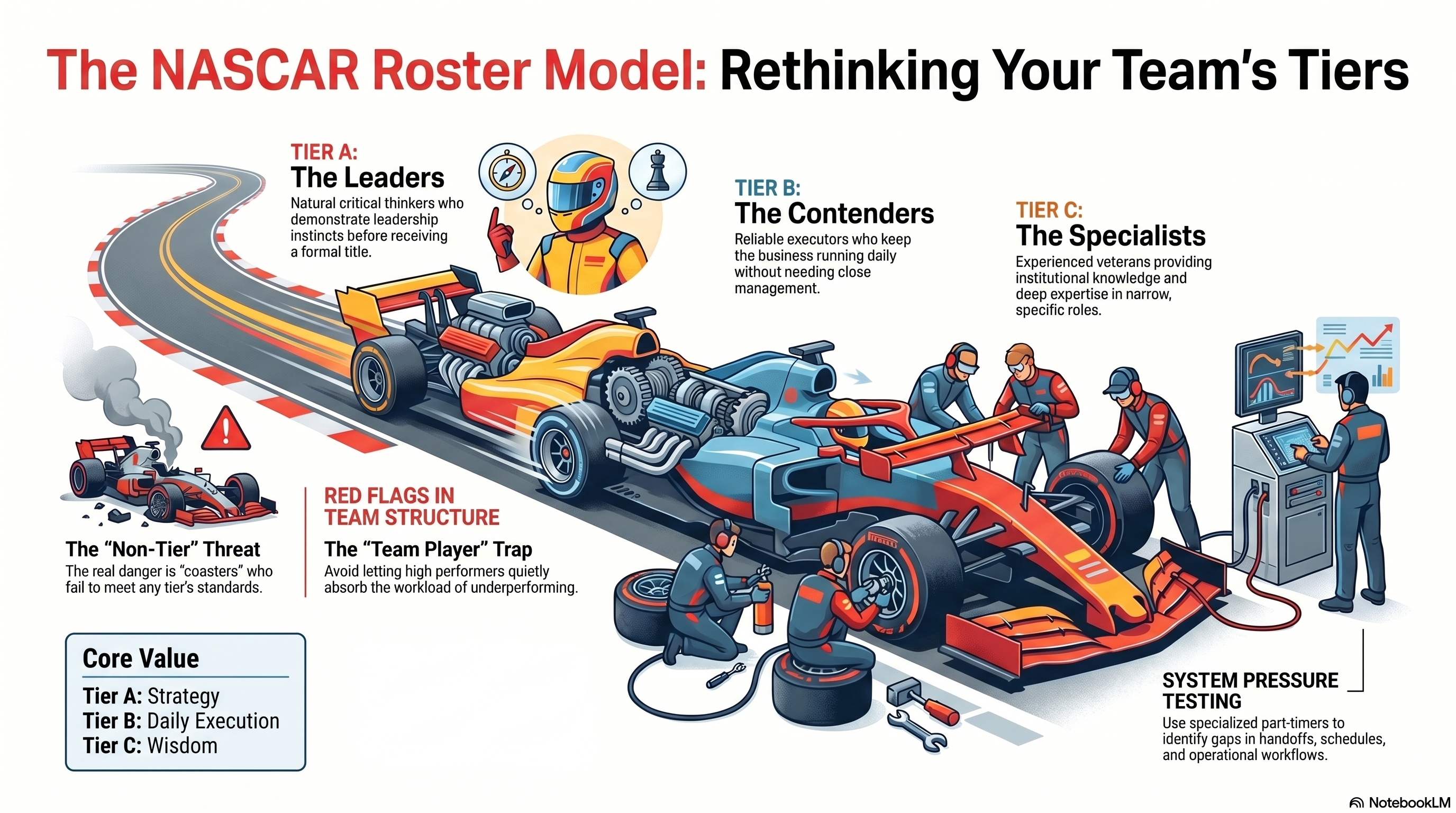
Here is where it actually goes wrong, and it isn't the C-players. It's when someone on your team isn't operating at the level of any tier. They're not leading like an A. They're not reliably executing like a B. They're not bringing the specific wisdom of a well-used C. They're just present, and someone else — usually your best B or your only A — ends up quietly doing the work that person was supposed to be doing. That is not a tier problem. That is a standard problem, and it gets disguised as a culture problem because nobody wants to be the one who calls it out.
The damage isn't that you have a C-player on the roster. The damage is letting "team player" become code for absorbing someone else's job indefinitely. The fix isn't cutting your C-tier. It's getting honest about who is actually performing inside their lane and who is coasting inside a title they're not earning. A genuine C-player — the part-timer with twenty years of trade knowledge — is worth more to your business than a B-player who shows up but never closes the gap between what they're paid to do and what they actually do.
What the Part-Timer Teaches You
There's a second layer to the C-tier I didn't expect until I started actually building teams instead of fantasy rosters. Almost every time you bring a part-time, narrow-lane person onto your team, you learn something about your own operation that you didn't know before. Not because they're trying to get away with anything, but because working a specific shift in a specific lane puts them right up against the edges of how you've actually built things, not how you assumed you built them. If there's a soft spot in how hours get logged, an unclear line in who covers what, or a gap in a handoff between shifts, the person working closest to that edge is going to find it first.
The instinct a lot of owners have in that moment is to assume the person is exploiting something. I wrote about this before in a post on assuming positive intent in management, and it applies directly here. Before you decide someone took advantage of a gap, ask the more useful question first: did this person find something true about my system that I hadn't noticed yet. Almost every time, that's the real answer. The gap was already there. They just happened to be the first person whose role put them close enough to see it.
That makes a good C-player worth more than the wisdom they carry day to day. They become a kind of pressure test on your operation — the early version of a problem you would have eventually hit with someone less careful, at a worse time. Treat what they surface as a flaw in the system you get to fix now, not a flaw in the person who found it.
Getting Honest About Who Is in Which Tier
If you're early-stage and still doing five jobs yourself, this is the moment to get specific instead of general. Don't ask who's an A and who's a C. Ask whether each person on your team is actually performing at the level their role requires, whatever that level is. A part-time veteran running their specific shift and sharing what they know is doing their job well. Someone in a full-time role who isn't leading, isn't executing, and isn't contributing knowledge is not doing their job at all, regardless of what title sits next to their name.
Once you can see that distinction clearly, the decision gets easier. You stop quietly covering for the person who isn't performing, because you finally know that's what's actually happening instead of mistaking it for being a team player. And you stop undervaluing the C-tier person who is doing exactly what their role asks of them, because you stop measuring everyone against the same yardstick.
Build the Roster Before You Set the Schedule
This is also where it pays to think about team building the same way you'd build a roster from the start, instead of only diagnosing one after the fact. If you're starting a team from the ground up, or sitting down to reevaluate the one you already have, build in a real opportunity for each person to show you which tier they're actually in before you lock a schedule around them. That means structuring shifts and responsibilities so a strong performer's output stands on its own, instead of folding into a schedule that quietly uses their overproduction to paper over two or three weaker slots you never meant to create.
The practical test is to look at your schedule the way you'd look at a roster, not a grid of hours. For every block, ask whether you've built in an unspoken assumption that one strong person will cover the gap if someone else comes up short. If the answer is yes, that isn't an efficient schedule. It's a structural problem wearing an efficiency costume, and it will eventually run your best person into the ground. Staff and schedule based on what each person has actually shown you, not on what you're hoping the group average will cover.
I'd rather build a roster like that Fantasy NASCAR lineup. A few drivers who can win outright, a strong field that finishes well every week, and a handful of specialists who know exactly what they're there for and deliver it. That's a team. A pile of people who all share one title but only some of whom are actually doing the work is not.
This is the kind of team building and staffing work we help SWFL business owners think through at Gulf Coast Concepts, alongside the brand and execution side of the business. Whether you're building a team from scratch or trying to get honest about the one you have — from staffing structure to figuring out who's actually in which tier — it's worth a conversation. Let's talk.
Jonathan
Have a question about this? Reach out directly.